
Description
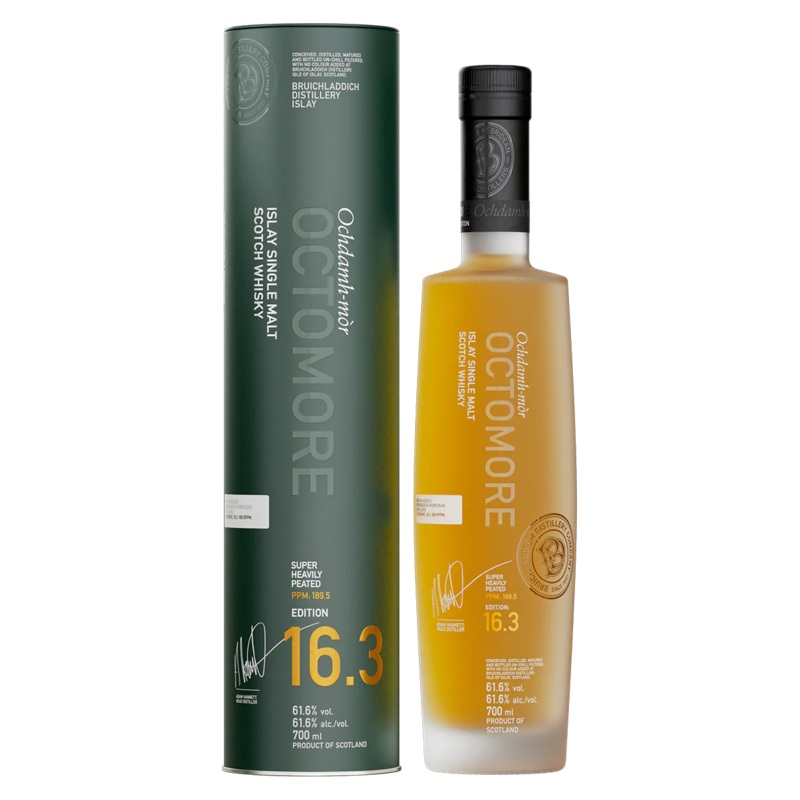
Bruichladdich Octomore 16.3 Super Heavily Peated 700ML is a cask-strength Islay single malt Scotch whisky bottled at 61.6% ABV in a 700ml format. Distilled from 100% Islay-grown Concerto barley peated to a staggering 189.5 PPM and matured across three distinct cask types, the 16.3 carries an 88.07/100 rating on Whiskybase from 165 user ratings a strong consensus for an expression that redefines the relationship between peat intensity and elegance.
Quick Facts: ABV: 61.6% | Origin: Islay, Scotland | 5-Year Age Statement | Distillery: Bruichladdich
Production & Heritage
Bruichladdich Distillery, founded in 1881 on the Rhinns of Islay and now owned by Rmy Cointreau, produces the Octomore range as the world’s most heavily peated single malt series. The 16.3 expression the “.3” denoting Islay-sourced barley uses Concerto barley grown on a single field at Octomore Farm, located just above the distillery. After distillation in Bruichladdich’s tall Victorian-era pot stills, the spirit matured for five years in a combination of ex-bourbon, Sauternes, and Pedro Ximnez sherry casks, then was bottled at natural cask strength without chill filtration or added color.
Tasting Notes
Aroma: Honeyed malt and ripe barley open first, quickly joined by citrus peel and orchard fruit apricot, apple, tangerine. A second wave brings delicate smoke, sea salt, and toasted grain, revealing more nuance than the PPM figure might suggest.
Taste: The entry is dense with layered smoke and toasted grain, but the mid-palate pivots sharply toward sweetness: dark chocolate, orange marmalade, and a bold raisin character driven by the Pedro Ximnez cask influence. Cinnamon spice and saline minerality build toward the peak, creating a push-pull between sweet richness and coastal brine.
Finish: Long and powerful, with lingering peat smoke braided through dark dried fruit, oak spice, and sweet tobacco. An earthy saline echo stays well after the glass is empty.
How to Drink Octomore 16.3
Neat with a few drops of water is the ideal starting point the cask-strength potency at 61.6% ABV opens considerably with dilution, unlocking the Sauternes-influenced fruit notes that sit beneath the peat. On the rocks works as well, though be aware that excessive ice can mute the sherry cask complexity.
For cocktails, the 16.3’s extreme peat and dark fruit intensity make it a powerful modifier. A Penicillin becomes something otherworldly when the Octomore replaces the smoky float, amplifying the ginger-honey backbone. In an Old Fashioned, the Pedro Ximnez sweetness harmonizes naturally with demerara syrup, needing only a dash of Angostura. A Rob Roy built with sweet vermouth draws out the raisin and chocolate tones, creating a deeply savory aperitif.
Best For
- Gifting a serious peat enthusiast something at the extreme edge of the category
- Anchoring a comparative tasting across the Octomore .1, .2, and .3 sub-series
- Marking a milestone occasion with a limited annual release
- Adding a rare, cask-strength Islay expression to a whisky collection
Frequently Asked Questions
What does Octomore 16.3 taste like? Despite its extreme 189.5 PPM peat level, the dominant impression is one of layered sweetness dark chocolate, orange marmalade, raisin, and honey riding alongside dense smoke and coastal salinity. Critics have described it as surprisingly soft and balanced for its intensity, with the Pedro Ximnez and Sauternes cask influence tempering the raw peat power.
How does Octomore 16.3 compare to Ardbeg Supernova? Ardbeg Supernova was developed as a direct competitor to the Octomore series, using super-highly peated malt, though its PPM levels typically fall well below Octomore’s 189+ range. The 16.3’s triple-cask maturation in bourbon, Sauternes, and Pedro Ximnez creates a sweeter, more fruit-forward profile, while Supernova tends toward a more austere, smoke-dominant character.
Is Octomore 16.3 good for sipping neat? Absolutely neat with a small addition of water is the recommended serve, allowing the cask-strength spirit at 61.6% ABV to open up and reveal the full spectrum of fruit, peat, and spice without overwhelming the palate.
Where is Octomore 16.3 made? Octomore 16.3 is distilled at Bruichladdich Distillery on the western shore of the Rhinns of Islay, Scotland. The Concerto barley is grown on a single field at Octomore Farm, located on the same island just above the distillery, making it a genuinely single-estate Islay expression.
What foods pair well with Octomore 16.3? Dark chocolate truffles complement the PX-driven cocoa and raisin notes. Smoked oysters or smoked salmon echo the coastal salinity and peat. Aged Comt or Gruyre match the intensity without competing. A citrus-glazed duck breast mirrors the orange marmalade character. Blue cheese, particularly Roquefort, provides a salty counterpoint to the whisky’s sweetness.
What sizes does Octomore 16.3 come in? Octomore 16.3 is released in the standard 700ml format, which is the single bottle size for this expression.
Is Octomore 16.3 worth the price? Octomore 16.3 positions firmly in the ultra-premium tier, justified by its single-estate Islay barley provenance, triple-cask maturation, cask-strength bottling, and limited annual production. Within the world of heavily peated single malts, few expressions match its combination of terroir specificity and complexity, making it a strong value proposition for collectors and peat devotees relative to other ultra-premium Islay bottlings.
Why Octomore 16.3?
The defining distinction of the 16.3 lies in its single-field, single-farm Islay barley a level of terroir transparency almost unheard of in Scotch whisky. At 189.5 PPM, it ranks among the most heavily peated whiskies ever commercially released, yet the combination of Sauternes and Pedro Ximnez cask maturation produces a spirit that critics at Drinkhacker called “a real softy” compared to other .3 releases, noting that “the whisky makes room for lots more beyond peat.” That tension between extremity on paper and finesse in the glass is what separates Octomore 16.3 from every other peat-forward malt on the shelf proof that phenol levels alone tell only half the story.
Reviews
There are no reviews yet.